
OST TO PST CONVERTER SOFTWARE
File converter software
- Features
- Ease of use
- Ease of management
- Quality of support
- Affordability
- Market presence
Take the quiz to check if OST TO PST CONVERTER SOFTWARE and its alternatives fit your requirements.

 Free Trial unavailableFree version unavailable

Small

Medium

Large

- Information technology and software
- Professional services (engineering, legal, consulting, etc.)
- Banking and insurance
What is OST TO PST CONVERTER SOFTWARE
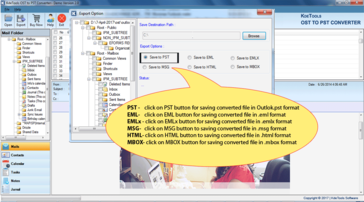
OST TO PST CONVERTER SOFTWARE is a utility designed to convert Microsoft Outlook Offline Storage Table (OST) files into Personal Storage Table (PST) files for use in Outlook and related email migration or recovery workflows. It is typically used by IT administrators, help desks, and individuals who need to access mailbox data when an Exchange profile is unavailable or when moving data between systems. The product focuses on email-data conversion rather than general document/PDF editing, and it commonly supports exporting mailbox items such as emails, contacts, calendars, and attachments.

Purpose-built OST to PST conversion
The product’s core function aligns with a common Outlook/Exchange support scenario: turning OST data into a portable PST file. This specialization can simplify workflows compared with general file conversion tools that do not handle Outlook mailbox formats. It is relevant for mailbox access, migration, and recovery use cases where PST is the required output format.
Supports mailbox item structures
OST-to-PST converters typically preserve mailbox folder hierarchy and common item types (mail, contacts, calendars, tasks) during export. This helps maintain usability after conversion, especially for users who rely on folder organization. It also reduces manual rework compared with exporting items one-by-one from Outlook.
Useful for admin support workflows
In many environments, OST files exist on endpoints while server-side access may be constrained by account, profile, or connectivity issues. A dedicated converter can provide a practical path to extract data for eDiscovery, user offboarding, or incident response. This makes it a focused tool for IT operations rather than end-user document handling.

Vendor identity is unclear
The product name is generic and does not uniquely identify a specific publisher, which makes it difficult to verify ownership, support channels, and update cadence. Multiple vendors use similar naming for OST/PST utilities, and capabilities vary significantly by publisher. Without a confirmed vendor, procurement and risk assessment (security, licensing, support) are harder.
Windows and Outlook dependencies
OST/PST tooling commonly targets Windows environments and may require Outlook components or MAPI dependencies for certain operations. This can limit use in macOS/Linux environments or in locked-down enterprise images. It may also complicate automation compared with server-side conversion services.
Conversion edge cases and limits
OST files can be tied to specific profiles, encryption states, or corruption scenarios that not all converters handle consistently. Large mailboxes, uncommon item types, or complex metadata (rules, categories, flags) may not fully transfer depending on implementation. Validation and post-conversion checks are often required to ensure completeness.


