Kuroco
CMS tools
Headless CMS software
WebOps platforms
- Features
- Ease of use
- Ease of management
- Quality of support
- Affordability
- Market presence
Take the quiz to check if Kuroco and its alternatives fit your requirements.

Pay-as-you-go
 Free Trial unavailable
 Free version

Small

Medium

Large

-
What is Kuroco
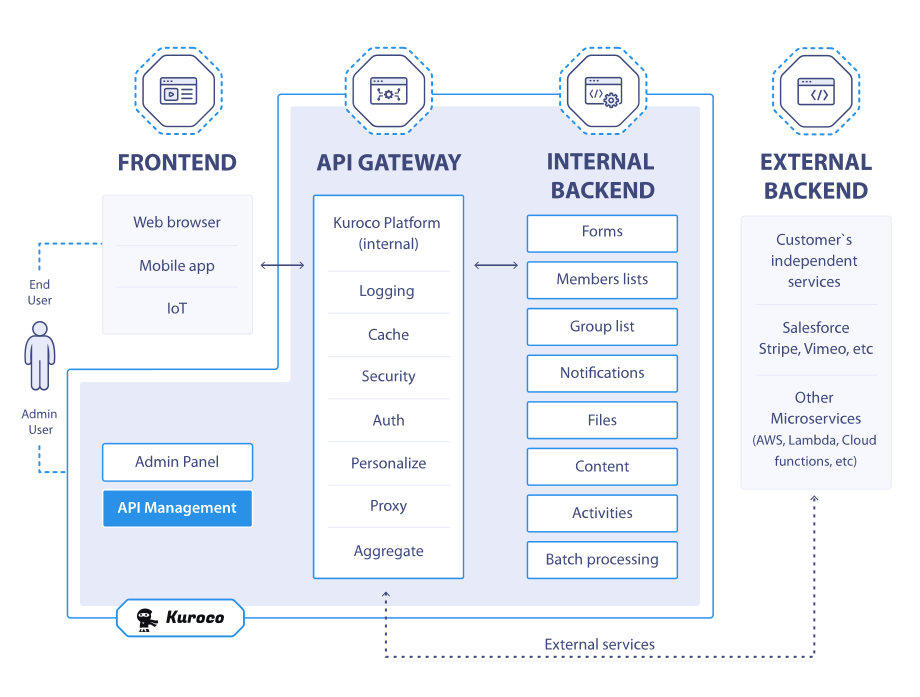
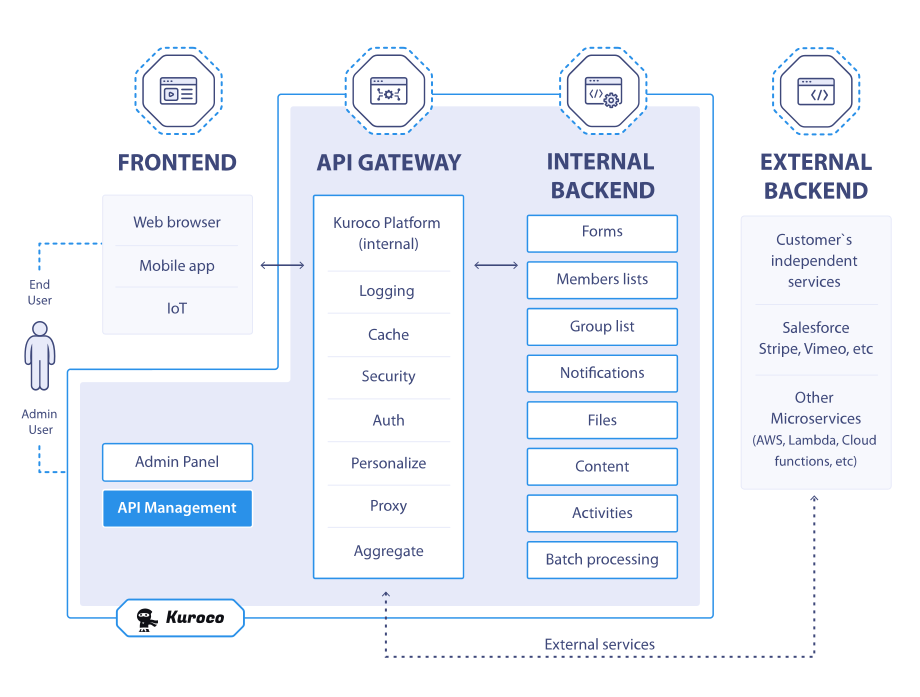
Kuroco is a headless CMS and API platform used to manage content and deliver it to websites, mobile apps, and other digital channels via APIs. It targets development teams and digital product owners that need a backend for content, membership, and data-driven experiences without coupling to a specific front-end framework. The product emphasizes API-first delivery, extensibility, and operational controls for running content-driven services. It is typically used in custom web/app builds where teams want centralized content management and integration with external systems.

API-first content delivery
Kuroco is designed around API-based delivery, which fits teams building custom front ends and multi-channel experiences. This approach supports decoupled architectures where content is reused across web, mobile, and other endpoints. It also aligns with organizations that need to integrate content with external services through APIs rather than page-centric tooling.
Supports custom integrations
The platform is positioned for projects that require integration with existing enterprise systems (for example, identity, commerce, or internal data sources). A headless model generally makes it easier to connect content workflows to external applications compared with site-builder-oriented tools. This is useful for teams that need content operations to sit inside broader digital workflows.
Operational controls for WebOps
Kuroco is used as a backend service that can support governance and operational practices around content publishing and delivery. This can help teams separate responsibilities between content editors and developers while maintaining controlled release processes. It is relevant for organizations that treat content delivery as an ongoing operational function rather than a one-time site build.

Requires developer-led implementation
As a headless CMS, Kuroco typically requires a separate front-end build and ongoing engineering support. Teams looking for an all-in-one visual site builder or low-code publishing experience may find it less suitable. Implementation effort and time-to-launch can be higher than page-centric CMS tools for simple sites.
Less suited to simple publishing
Organizations that primarily need straightforward document publishing, newsletters, or lightweight membership gating may not need a full headless CMS and API platform. For those use cases, specialized tools can be faster to configure and operate. Kuroco is generally a better fit when content must be orchestrated across multiple channels and systems.
Vendor details not fully verifiable
Publicly verifiable corporate details (such as definitive founding year, headquarters, and corporate status) are not consistently available from authoritative sources in this context. Buyers may need to confirm ownership, support model, and regional availability directly with the vendor. This can add diligence effort compared with vendors with widely published corporate profiles.
Plan & Pricing
Pricing model: Pay-as-you-go (fully usage-based) Free tier/trial: Free usage up to $12/month (general Kuroco free tier); KurocoFront: free up to 50GB/month (noted as a 1,100 JPY/month free tier). No setup fees; monthly billing.
Example costs (from official Kuroco docs/site):
- Cached API requests – $0.37 per 10,000 hits.
- API requests (non-cached) – $0.46 per 1,000 hits.
- CDN / media data transfer – $1.00 per 5 GB (Kuroco core); KurocoFront page lists $1.10 per 5 GB for its hosting service.
- Computing (additional processing time) – $0.0001 per 1,000 ms (charged when API response time exceeds 300 ms or for batch processing time).
- File storage / DB / logs – example shows $0.50 per GB (file storage billed on peak usage during billing period).
Billing notes & discounts:
- Usage is rounded up to billing units (e.g., 100 API hits rounds up to the 1,000-hit unit).
- File storage is billed on the peak value during the aggregation period.
- Fixed-price contracts or monthly estimates and volume/enterprise discounts are available on request (contact sales).
Free-plan / trial details (official wording):
- "Kuroco is free of charge for up to $12 (tax included) per month of usage." (no credit card required to sign up).
- KurocoFront: "Free up to 50GB/month" (noted as a 1,100 JPY/month free tier); credit card must be registered within first month or before 70% of the tier fee is used.
Notes / caveats:
- Some per-item unit prices appear in examples and documentation pages; for large or high-cost deployments Kuroco also offers annual/enterprise packages (e.g., ISMAP-compliant private cloud packages from ¥4,620,000/yr — contact sales for details).
- Where multiple pages show slightly different CDN unit prices (e.g., $1.00/5GB vs $1.10/5GB) those correspond to different product pages (core Kuroco vs KurocoFront) and/or regional/JPY displays.
Seller details

Diverta Inc.

Tokyo, Japan

2001

Private

https://kuroco.app/

https://x.com/diverta_kuroco

https://www.linkedin.com/company/diverta-inc