Odoo ERP
Accounting software
Discrete ERP software
ERP systems
HCM software
Accounting & finance software
ERP for school management software
ERP for textile industry software
ERP retail software
AI ERP tools
Government ERP software
- Features
- Ease of use
- Ease of management
- Quality of support
- Affordability
- Market presence
Take the quiz to check if Odoo ERP and its alternatives fit your requirements.

$31.10 per user per month
 Free TrialFree version

Small

Medium

Large

- Accommodation and food services
- Retail and wholesale
- Arts, entertainment, and recreation
What is Odoo ERP
Odoo ERP is a modular enterprise resource planning suite that combines finance, sales, purchasing, inventory, manufacturing, HR, and other business applications on a single platform. It is used by small to mid-sized organizations and divisions of larger enterprises that want configurable workflows and an integrated database across functions. Odoo is available as a vendor-hosted cloud service and as a self-managed deployment, with a large ecosystem of official and third-party apps. Its differentiators include open-source roots, broad module coverage, and extensive customization options via configuration and development.

Broad, modular suite coverage
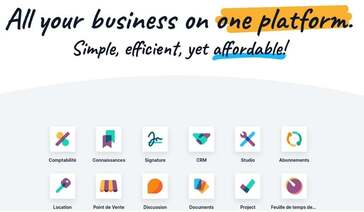
Odoo provides a wide set of integrated modules (e.g., accounting, CRM, inventory, manufacturing, HR) that share a common data model. This reduces the need to stitch together multiple point solutions for core back-office processes. Organizations can start with a small footprint and add modules as requirements expand. The module approach supports varied use cases such as retail operations, discrete manufacturing, and service delivery.
Flexible deployment and extensibility
Odoo supports both SaaS (Odoo Online/Odoo.sh) and on-premises/self-hosted deployments, which can help meet data residency or IT control requirements. The platform is designed for customization through configuration, Odoo Studio (in supported editions), and custom development. A large app marketplace and partner network expands functionality for industry-specific needs. This flexibility is often a deciding factor for teams that require tailored workflows.
Integrated business process workflows
The suite links front-office and back-office processes (e.g., sales to invoicing, purchasing to inventory, manufacturing to costing) within one system. This can improve traceability and reduce duplicate data entry compared with using separate accounting and operations tools. Built-in automation and rules (e.g., reordering, approvals, document flows) support standardized operations. Reporting can draw from unified transactional data across modules.

Customization increases complexity
While customization is a strength, it can also create implementation and maintenance overhead, especially when many modules and third-party apps are involved. Upgrades may require regression testing and refactoring of custom code or integrations. Organizations without strong internal admin/development capability often rely on partners, which can increase total cost and project risk. Governance is important to prevent inconsistent configurations across departments.
Edition and feature variability
Capabilities differ between the Community (open-source) and Enterprise editions, and some features depend on the hosting option (Online vs Odoo.sh vs on-premises). This can complicate evaluation, budgeting, and long-term roadmap planning. Certain advanced functions (e.g., some accounting localizations, studio tooling, or enterprise-only modules) may require Enterprise licensing. Buyers typically need a detailed requirements-to-edition mapping during selection.
Localization and compliance gaps
Accounting, payroll, and statutory reporting requirements vary significantly by country and industry, and coverage can depend on localizations and partner-built modules. Public-sector or regulated environments may require additional controls (e.g., audit trails, segregation of duties, procurement rules) that need configuration or extensions. Industry-specific needs (e.g., school management, textiles, government processes) often require add-ons and careful validation. Organizations should confirm local compliance support and implementation references for their jurisdiction.
Plan & Pricing
| Plan | Price | Key features & notes |
|---|---|---|
| One App Free | $0 (One app, unlimited users) | Odoo Online; free forever for one chosen app; dependent required apps included; multiple companies allowed. |
| Standard | US$31.10 per user/month (price shown on Odoo pricing page; may show a local-currency variation alongside USD) | Includes access to all Odoo apps and Odoo Online hosting; billed per user/month; "Free Trial" option shown on official pricing page. |
| Custom | US$61.00 per user/month (price shown on Odoo pricing page) | Includes all apps; supports Odoo Online, Odoo.sh, or on-premise hosting; includes Odoo Studio, multi-company and External API; "Free Trial" option shown. |
Additional official configurable/usage costs (from Odoo Pricing Configurator):
- Odoo.sh workers: US$72.00 / month (shown, with discounted rate US$57.60 listed).
- Storage: US$0.25 / GB / month (shown, with discounted rate US$0.20 listed).
- Staging environment: US$18.00 / month (shown, with discounted rate US$14.40 listed).
- Dedicated server option: US$600.00 / month (shown, discounted US$480.00 listed).
- Hosting types: Standard Cloud Hosting and Self Hosting are listed as "Free" in the configurator; Odoo.sh has separate costs.
Seller details

Odoo S.A.

Ramillies, Belgium

2005

Private

https://www.odoo.com/

https://x.com/Odoo

https://www.linkedin.com/company/odoo/