
Find your right-fit generative AI, agents, apps.
Best accounting & finance software February 2026
Which best describes what you want to do?
Top picks by use case
Small business general ledger
Target audience
Small business owners and solo operators managing their own books without a dedicated controller.
Overview
Designed for business owners who need a complete financial record system they can operate without a trained accountant on staff. These tools prioritize fast bank reconciliation, integrated invoicing, and tax-ready reporting over multi-entity complexity or lengthy implementation cycles.
Fit & gap perspective
🏦Bank reconciliation
Automatic bank feed import with rule-based transaction matching that keeps the ledger current without manual data entry.
🧾Integrated invoicing
Create, send, and track customer invoices directly from the general ledger without switching to a separate billing tool.
Top picks

Our pick for: All-in-one small business accounting


$19 per month
 Free Trial
 Free version unavailable

Small

Medium

Large

- Accommodation and food services
- Retail and wholesale
- Arts, entertainment, and recreation
FitGaps's take


Pros and cons


Our pick for: Cloud-native collaboration with advisors
$25 per month
Free TrialFree version unavailableSmall
Medium
Large
- Arts, entertainment, and recreation
- Retail and wholesale
- Accommodation and food services
FitGaps's take
Pros and cons
Our pick for: Service-based freelancers and micro-businesses

$9.20 per month
Free TrialFree version unavailableSmall
Medium
Large
- Media and communications
- Professional services (engineering, legal, consulting, etc.)
- Information technology and software
FitGaps's take

Pros and cons
Mid-market and multi-entity finance suite
Target audience
Mid-market finance teams with a controller or CFO managing multi-entity or multi-currency operations.
Overview
Built for organizations that have outgrown single-company bookkeeping and now require consolidated reporting across subsidiaries, currencies, and departments. These platforms deliver audit-ready controls and dimensional analysis without the overhead of a full enterprise ERP implementation.
Fit & gap perspective
🌐Multi-entity consolidation
Automated inter-company eliminations and consolidated financial statements that reconcile across all subsidiaries in a single close cycle.
🔒Audit-ready controls
Role-based permissions, structured approval workflows, and immutable audit trails on every journal entry and configuration change.
Top picks
Our pick for: Dimensional, multi-entity accounting

Contact the product provider
Free TrialFree version unavailableSmall
Medium
Large
- Real estate and property management
- Healthcare and life sciences
- Public sector and nonprofit organizations
FitGaps's take

Pros and cons
Our pick for: Unified ERP-grade financials at scale

Contact the product provider
Free Trial unavailableFree version unavailableSmall
Medium
Large
- Arts, entertainment, and recreation
- Media and communications
- Information technology and software
FitGaps's take

Pros and cons
Our pick for: Microsoft-ecosystem finance operations

$8.00 per user per month, paid yearly
Free TrialFree version unavailableSmall
Medium
Large
- Real estate and property management
- Arts, entertainment, and recreation
- Retail and wholesale
FitGaps's take

Pros and cons
Enterprise financial close and performance management
Target audience
Enterprise controllers, corporate FP&A leaders, and shared-service centers at organizations with complex regulatory obligations.
Overview
Addresses the governance and speed demands of large organizations that must close the books across dozens of legal entities while satisfying multi-jurisdictional compliance requirements. These platforms automate reconciliation, close task orchestration, and disclosure reporting, and connect planning models directly to ledger actuals in a tightly governed environment.
Fit & gap perspective
⏱️Close management
Orchestrated task assignment, automated reconciliation, and real-time status dashboards that measurably compress the period-end close cycle.
📊Planning-to-actuals integration
Native linkage between budget models, rolling forecasts, and live ledger data that supports continuous variance analysis without manual exports.
Top picks
Our pick for: End-to-end enterprise financial backbone

Contact the product provider
Free Trial unavailableFree version unavailableSmall
Medium
Large
- Banking and insurance
- Media and communications
- Arts, entertainment, and recreation
FitGaps's take

Pros and cons
Our pick for: Worktag-driven analytics and continuous close

Contact the product provider
Free Trial unavailableFree version unavailableSmall
Medium
Large
-
FitGaps's take

Pros and cons
Our pick for: Process-integrated enterprise finance

Contact the product provider
Free TrialFree version unavailableSmall
Medium
Large
- Manufacturing
- Energy and utilities
- Healthcare and life sciences
FitGaps's take

Pros and cons
Accounts payable and spend automation
Target audience
AP managers and procurement-adjacent finance teams processing high invoice volumes across multiple vendors.
Overview
Solves the manual bottleneck of high-volume invoice processing by automating capture, approval routing, and payment execution. These tools prioritize fraud prevention and cycle-time reduction over general-ledger breadth, making them the decisive layer between vendor invoices and cash disbursement.
Fit & gap perspective
🤖Automated invoice capture
AI or OCR extraction of header and line-item data from PDF and email invoices, eliminating manual keying into the payables ledger.
✅Approval routing
Configurable multi-level approval workflows with delegation rules, spend thresholds, and mobile access that keep invoices moving without chasing approvers.
Top picks
Our pick for: Global payables and mass payment execution

$99 per month
Free Trial unavailableFree version unavailableSmall
Medium
Large
- Information technology and software
- Media and communications
- Arts, entertainment, and recreation
FitGaps's take

Pros and cons
Our pick for: SMB-friendly payables workflow

$49 per user per month
Free TrialFree version unavailableSmall
Medium
Large
- Agriculture, fishing, and forestry
- Professional services (engineering, legal, consulting, etc.)
- Arts, entertainment, and recreation
FitGaps's take

Pros and cons
Our pick for: Invoice-centric collaboration and AI coding

Contact the product provider
Free TrialFree version unavailableSmall
Medium
Large
- Agriculture, fishing, and forestry
- Arts, entertainment, and recreation
- Construction
FitGaps's take

Pros and cons
Selection compass: how to prioritize requirements
What is selection compass?
FitGap scored 943 accounting and finance products against a requirement framework informed by real-world buyer research and verified specifications across dozens of evaluation axes to identify where vendor approaches diverge most sharply and where the market has converged on baseline expectations.
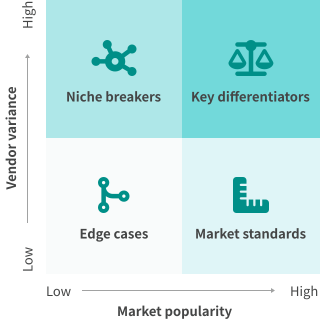
Key differentiators
🏗️Data model architecture and reporting flexibility
Whether the system uses dimensional tagging or hierarchical account strings determines how much IT effort every new reporting cut requires.
🔄Close cycle automation depth
Vendors range from basic checklists to fully orchestrated reconciliation engines — the gap directly determines how many days your close takes.
💱Multi-currency and multi-entity consolidation
Some platforms consolidate natively in one data model; others require manual export-reload cycles that introduce timing risk and reconciliation errors.
🤖AI and OCR automation ceiling
Invoice capture accuracy and GL coding suggestion quality vary widely, determining whether automation reduces headcount or merely shifts where errors occur.
📐Planning-to-ledger integration depth
Native linkage between budgets and live actuals eliminates manual exports; loosely coupled tools create variance analysis lag that distorts decision-making.
💸Total cost of ownership at scale
Module pricing, entity fees, and implementation complexity create order-of-magnitude TCO variance that list-price comparisons consistently understate.
Niche breakers
🌍Statutory and multi-GAAP compliance
Organizations posting under both IFRS and local GAAP simultaneously require native parallel-ledger support — absent this, manual parallel maintenance is unavoidable.
🏭On-premise or private-cloud deployment
Regulated industries with data-residency mandates cannot use SaaS-only vendors — absence of a deployment option eliminates the product outright.
🔗ERP operational-to-financial real-time posting
Manufacturers and project firms where a goods receipt or milestone must post instantly to the ledger cannot tolerate batch-sync architectures.
🌐Mass cross-border payment execution
High-volume international AP operations require built-in multi-rail disbursement and sanctions screening — a payables-only tool without this creates an unworkable compliance gap.
📑Grant and fund accounting
Nonprofits and public-sector entities with fund-restricted reporting requirements cannot work around the absence of native fund accounting — it is an architectural prerequisite.
Market standards
🏦Bank feed import and reconciliation
Automatic transaction import with rule-based matching is a baseline expectation — products lacking it are not viable for any segment.
🔐Role-based access and audit trail
Granular permissions and immutable posting history are required at every tier; absence fails even basic internal-control standards.
🧾Accounts payable and receivable workflows
Core AP and AR processing, including invoice entry and payment tracking, is table-stakes functionality across the entire category.
📊Standard financial reporting
Balance sheet, income statement, and cash flow statement output is universally expected — the differentiator is flexibility beyond these templates.
Edge cases
📱Offline mobile data entry
Field-based expense capture without connectivity matters for construction and field-services firms but is irrelevant for office-bound finance teams.
🏥Healthcare or government-specific chart of accounts
Agencies and health systems required to comply with USSGL or HFMA-mandated account structures need pre-built templates unavailable in general-purpose tools.
🪙Cryptocurrency and digital asset accounting
Organizations holding or transacting in digital assets need native token ledger support — only a narrow set of vendors has built this natively.
How to choose
1.Workflow design
Start by mapping the financial workflows the system must make reliable, not just the reports it must produce. Define the scope: how many legal entities, currencies, and regulatory frameworks are in play? Identify the actors — owner-operator, AP clerk, controller, FP&A analyst — and trace the path from a source transaction to a closed period and a filed return. For example, a three-entity business with intercompany loans has a fundamentally different workflow map than a single-entity services firm billing hourly, and conflating the two leads to over-buying or under-buying.

Still looking for the perfect fit?
Whether you want our AI-powered engine to recommend the best match for your goals or prefer to browse our comprehensive directory, we have you covered.
Frequently asked questions
What is accounting and finance software, in practical terms?
Who uses accounting and finance software inside an organization?
What separates a general ledger tool from an ERP finance module?
What are the most important benefits of purpose-fit accounting software?
Unpleasant truth: Why do accounting software implementations fail after go-live?
How do we decide between a standalone accounting tool and a full ERP suite?
What pricing models are common in this category?
Unpleasant truth: What hidden costs should every buyer budget for?
What is the minimum viable setup for a small business starting out?
What integrations matter most when evaluating accounting software?
Unpleasant truth: Why does multi-entity consolidation take longer than vendors suggest?
How should we evaluate AP automation tools relative to our existing GL?
What are the main trends shaping accounting and finance software right now?
How do we know when we have outgrown our current accounting platform?
What if no product on our shortlist fully fits our requirements?


