
Find your right-fit generative AI, agents, apps.
Best downloadable e-commerce software February 2026
Which best describes what you want to do?
Top picks by use case
Self-hosted storefront engine
Target audience
Dev-capable merchants or agencies building bespoke online stores on owned infrastructure.
Overview
Designed for teams that demand full ownership of their commerce codebase, these platforms install on your own infrastructure and impose no cloud vendor dependency. Greater setup and maintenance effort is the accepted trade-off for data sovereignty, unrestricted customization, and complete control over release cadence.
Fit & gap perspective
🔧Source-level customization
Full source code access enabling teams to modify checkout flows, pricing logic, and catalog behavior without restriction.
🖥️Self-managed deployment
Installable on Windows Server or Linux with no mandatory cloud service dependency at runtime.
Top picks

Our pick for: Open-source .NET flexibility


$29.00 one-time
 Free Trial unavailable
 Free version

Small

Medium

Large

- Agriculture, fishing, and forestry
- Manufacturing
- Retail and wholesale
FitGaps's take


Pros and cons


Our pick for: MongoDB-backed modern architecture

Completely free
Free Trial unavailableFree versionSmall
Medium
Large
- Information technology and software
- Manufacturing
- Retail and wholesale
FitGaps's take

Pros and cons
Our pick for: Headless B2B commerce

Contact the product provider
Free Trial unavailableFree version unavailableSmall
Medium
Large
- Manufacturing
- Information technology and software
- Real estate and property management
FitGaps's take

Pros and cons
Order operations and fulfillment hub
Target audience
Multi-channel retailers who process high order volumes and sync to desktop accounting systems.
Overview
Built for sellers juggling orders across multiple marketplaces and carts, these downloadable tools centralize order routing, shipping labels, and accounting sync into a single local workflow. Back-office automation and financial accuracy take precedence over storefront presentation concerns.
Fit & gap perspective
🔗Channel aggregation
Pulls orders from multiple marketplaces and storefronts into a single, unified fulfillment queue.
🧾Accounting sync
Auto-posts revenue, fees, and tax entries to desktop accounting software, eliminating manual journal entries.
Top picks
Our pick for: Accounting-centric order sync

$19 per month
Free TrialFree version unavailableSmall
Medium
Large
- Retail and wholesale
- Manufacturing
- Accommodation and food services
FitGaps's take

Pros and cons
Our pick for: Multi-channel inventory orchestration

Contact the product provider
Free Trial unavailableFree version unavailableSmall
Medium
Large
- Retail and wholesale
- Agriculture, fishing, and forestry
- Construction
FitGaps's take

Pros and cons
Our pick for: Desktop shipping label automation

$9.95 per month
Free TrialFree version unavailableSmall
Medium
Large
- Arts, entertainment, and recreation
- Education and training
- Information technology and software
FitGaps's take

Pros and cons
Product content and catalog management
Target audience
Product, marketing, or catalog teams at manufacturers and distributors managing thousands of SKUs.
Overview
Aimed at organizations with large or complex catalogs, these local tools enrich, structure, and publish product data and visual assets across print and digital channels with precision. A single source of truth for product content feeds both web channels and print production, reducing cross-channel inconsistency at scale.
Fit & gap perspective
🗂️Product data modeling
Defines custom attribute schemas, validation rules, and taxonomy hierarchies that enforce completeness before publishing.
📤Multi-channel publishing
Exports enriched product data to web stores, print layouts, and marketplace feeds from one managed source.
Top picks
Our pick for: Structured product data mastery

Contact the product provider
Free Trial unavailableFree version unavailableSmall
Medium
Large
- Manufacturing
- Construction
- Agriculture, fishing, and forestry
FitGaps's take

Pros and cons
Our pick for: Automated print catalog production
 Free Trial unavailableFree version unavailable
Small
Medium
Large
- Media and communications
- Arts, entertainment, and recreation
- Accommodation and food services
FitGaps's take

Pros and cons
Our pick for: Omnichannel content hub

Contact the product provider
Free Trial unavailableFree version unavailableSmall
Medium
Large
- Media and communications
- Education and training
- Arts, entertainment, and recreation
FitGaps's take

Pros and cons
On-site customer engagement layer
Target audience
E-commerce operators adding chat, guided selling, or field-rep ordering to an existing store.
Overview
Focused on boosting conversion without replacing the underlying commerce platform, these downloadable tools overlay live chat, AI-assisted guidance, or field-rep ordering directly onto an existing storefront. Narrow functional scope is the deliberate trade-off for fast deployment and zero platform migration risk.
Fit & gap perspective
⚡Lightweight overlay deployment
Installs on top of any existing storefront without requiring changes to the underlying commerce platform.
📱Offline or desktop agent mode
Operates from a local application so agents or field reps can work without a live browser session.
Top picks
Our pick for: AI chatbot for small stores

$24.17 per month
Free TrialFree versionSmall
Medium
Large
- Retail and wholesale
- Accommodation and food services
- Real estate and property management
FitGaps's take

Pros and cons
Our pick for: Real-time sales conversations

$19 per user per month
Free TrialFree version unavailableSmall
Medium
Large
- Information technology and software
- Retail and wholesale
- Accommodation and food services
FitGaps's take

Pros and cons
Our pick for: Field sales B2B ordering

$500 per month
Free TrialFree version unavailableSmall
Medium
Large
- Retail and wholesale
- Agriculture, fishing, and forestry
- Manufacturing
FitGaps's take

Pros and cons
Selection compass: how to prioritize requirements
What is selection compass?
FitGap scored 29 downloadable e-commerce products against a requirement framework shaped by real-world buyer research — with verified specifications across dozens of evaluation axes — to identify where vendor approaches diverge most and where buyers consistently underestimate the stakes.
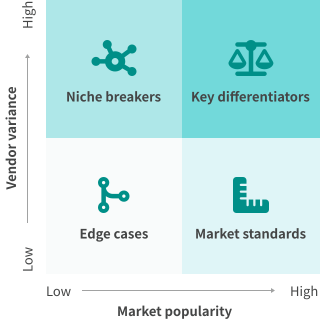
Key differentiators
🔒Data sovereignty and infrastructure ownership
How completely the buyer controls data storage, residency, and access — from full local ownership to partial cloud dependency.
🔄Offline operation and sync reliability
Whether the tool functions fully without live internet, and how conflict resolution works when connectivity is restored.
🧩Depth of accounting and ERP integration
Whether financial posting is real-time and bidirectional or batch-only, affecting reconciliation effort and bookkeeping accuracy.
📐Data model flexibility and schema extensibility
How easily custom attributes, taxonomies, or product families can be added without developer involvement or schema migrations.
🌐Multi-channel publishing and feed management
Whether enriched product data or inventory can be pushed to multiple storefronts and marketplaces from a single local source.
🏗️Source code access and customization ceiling
Whether buyers can modify core commerce logic at the code level or are constrained to plugin and configuration boundaries.
Niche breakers
📵True offline-first operation for field sales
For field reps in low-connectivity territories, tools that require any live session are non-viable regardless of other features.
🖥️QuickBooks Desktop compatibility
Organizations locked to QuickBooks Desktop cannot use cloud-native sync alternatives; local integration is a hard architectural requirement.
🖨️Local label printing without browser dependency
High-volume packing operations where session timeouts or internet outages halt label printing require a locally installed runtime.
🔐Full source code auditability for compliance
Regulated industries requiring security audits of the actual running codebase are blocked by black-box or obfuscated deployments.
Market standards
📦Order import and basic channel connectivity
Standard ability to pull orders from at least one major marketplace or storefront into the local application.
🔑Role-based access and user permissions
Basic user management with distinct roles for warehouse staff, catalog editors, and administrators as a minimum expectation.
📤Export to common formats
CSV, XML, or standard feed export for product data, orders, or shipment records without custom development.
Edge cases
🗃️Legacy OS or on-premises hardware constraints
Operations running Windows Server environments older than current LTS versions may face runtime compatibility issues.
🌍Multi-language and regional localization of local UI
Desktop agent tools used by non-English warehouse or field teams may require localized interfaces vendors rarely prioritize.
🔌Air-gapped or zero-internet deployment
Truly isolated networks with no outbound internet access may break license validation or update mechanisms in installed tools.
How to choose
1.Workflow design
Start by mapping the specific local workflow you need the downloaded software to make reliable — not the full commerce operation, just the part that must run on owned or managed infrastructure. Define who performs each step, what data enters and exits, and where internet dependency creates risk today. For example, map exactly how a warehouse packer moves from order receipt to label print, or how a field rep presents pricing and captures an order at a client site without a signal.

Still looking for the perfect fit?
Whether you want our AI-powered engine to recommend the best match for your goals or prefer to browse our comprehensive directory, we have you covered.
Frequently asked questions
What does 'downloadable' e-commerce software actually mean?
Is downloadable e-commerce software outdated compared to SaaS?
What are the four main categories of downloadable e-commerce tools?
Unpleasant truth: Who is actually responsible for security patches on downloaded software?
Unpleasant truth: Does 'offline capable' always mean fully offline?
What infrastructure do self-hosted storefront engines require?
Can I use a downloadable order hub alongside a cloud storefront like Shopify?
Unpleasant truth: What happens when the vendor stops supporting a downloaded version?
How does accounting integration depth vary across downloadable tools?
Is open-source the same as downloadable?
What is the typical total cost of ownership difference between downloadable and SaaS?
Unpleasant truth: Does a downloadable engagement overlay really avoid platform migration risk?
How do downloadable PIM tools differ from spreadsheet-based catalog management?
What should I verify before running a PoC for a self-hosted storefront engine?
Can downloadable e-commerce software scale to high order volumes?


