
Find your right-fit generative AI, agents, apps.
Best health care software February 2026
Which best describes what you want to do?
Top picks by use case
Enterprise hospital platform
Target audience
Health system CIOs and CMIOs managing multi-facility inpatient and ambulatory operations.
Overview
Large hospitals and health systems demand a single patient record that spans every department — from the ED and surgical suites to ambulatory clinics and revenue cycle. These platforms accept longer implementation timelines in exchange for deep cross-departmental integration and built-in regulatory reporting that scales across facilities.
Fit & gap perspective
🔗Cross-departmental integration
A unified patient record spanning ED, inpatient, surgical, and ambulatory encounters without interface engines between modules.
📊Regulatory reporting
Built-in quality measure dashboards that auto-generate CMS and state submissions without manual data extraction.
Top picks

Our pick for: Fully integrated health system backbone


Contact the product provider
 Free Trial unavailableFree version unavailable

Small

Medium

Large

- Information technology and software
- Media and communications
- Professional services (engineering, legal, consulting, etc.)
FitGaps's take


Pros and cons


Our pick for: Open-platform enterprise EHR

Contact the product provider
Free Trial unavailableFree version unavailableSmall
Medium
Large
- Public sector and nonprofit organizations
- Healthcare and life sciences
- Banking and insurance
FitGaps's take

Pros and cons
Our pick for: Community hospital value

Contact the product provider
Free Trial unavailableFree version unavailableSmall
Medium
Large
- Healthcare and life sciences
- Public sector and nonprofit organizations
- Banking and insurance
FitGaps's take

Pros and cons
Ambulatory practice all-in-one
Target audience
Independent physician practices and multi-provider outpatient groups with 1–50 clinicians.
Overview
Outpatient practices need charting, scheduling, and billing unified under one roof without enterprise complexity. These platforms prioritize rapid onboarding and intuitive workflows, letting small clinical teams spend less time on administration and more time delivering patient care.
Fit & gap perspective
🧾Integrated billing
Claim scrubbing, electronic remittance posting, and denial management embedded directly within the EHR workflow.
🚀Rapid deployment
Cloud-hosted setup with pre-built specialty templates enabling full go-live in weeks, not months.
Top picks
Our pick for: Cloud-native network intelligence

Pay-as-you-go
Free Trial unavailableFree version unavailableSmall
Medium
Large
- Healthcare and life sciences
- Banking and insurance
- Professional services (engineering, legal, consulting, etc.)
FitGaps's take

Pros and cons
Our pick for: Feature-dense ambulatory suite

$449 per provider per month
Free Trial unavailableFree version unavailableSmall
Medium
Large
- Healthcare and life sciences
- Public sector and nonprofit organizations
- Professional services (engineering, legal, consulting, etc.)
FitGaps's take

Pros and cons
Our pick for: Small practice simplicity

Contact the product provider
Free Trial unavailableFree version unavailableSmall
Medium
Large
- Healthcare and life sciences
- Public sector and nonprofit organizations
- Information technology and software
FitGaps's take

Pros and cons
Post-acute and home-based care
Target audience
Home health, hospice, and senior living operators managing distributed care teams.
Overview
Field clinicians documenting at the bedside or in a patient's home require mobile-first tools that work with or without connectivity. These platforms embed OASIS, MDS, and hospice-specific compliance logic directly into documentation workflows, reducing submission errors for distributed care teams.
Fit & gap perspective
📱Mobile point-of-care documentation
Offline-capable apps that capture visit notes and vitals in the field and sync automatically when connectivity resumes.
✅Payer compliance automation
Built-in OASIS, MDS, or hospice assessment logic that flags documentation gaps before claim submission.
Top picks
Our pick for: End-to-end home care operations

Contact the product provider
 Free TrialFree version unavailable
Small
Medium
Large
- Information technology and software
- Media and communications
- Professional services (engineering, legal, consulting, etc.)
FitGaps's take

Pros and cons
Our pick for: Compliance-driven home health
 Free TrialFree version unavailable
Small
Medium
Large
- Media and communications
- Healthcare and life sciences
- Banking and insurance
FitGaps's take

Pros and cons
Our pick for: Senior living and skilled nursing

$65 per App per Facility per month
Free Trial unavailableFree version unavailableSmall
Medium
Large
- Media and communications
- Healthcare and life sciences
- Agriculture, fishing, and forestry
FitGaps's take

Pros and cons
Specialty and therapy practice
Target audience
Solo and small-group specialty providers in behavioral health, therapy, dental, or niche medical fields.
Overview
General-purpose EHRs rarely reflect how behavioral health, physical therapy, or medical subspecialty clinicians actually document. These platforms deliver discipline-specific templates and billing logic on day one, accepting narrower cross-specialty flexibility in exchange for immediate workflow fit.
Fit & gap perspective
📋Specialty clinical templates
Pre-configured note types, assessment tools, and procedure codes tailored to the discipline's documentation norms.
💳Specialty billing rules
Automated coding logic tuned to the payer requirements and procedure mix unique to the specialty.
Top picks
Our pick for: Behavioral health and wellness

$15 per month
Free TrialFree version unavailableSmall
Medium
Large
- Healthcare and life sciences
- Professional services (engineering, legal, consulting, etc.)
- Media and communications
FitGaps's take

Pros and cons
Our pick for: Physical therapy and rehab

Contact the product provider
Free Trial unavailableFree version unavailableSmall
Medium
Large
- Information technology and software
- Media and communications
- Professional services (engineering, legal, consulting, etc.)
FitGaps's take

Pros and cons
Our pick for: Medical subspecialty depth

Contact the product provider
Free Trial unavailableFree version unavailableSmall
Medium
Large
- Healthcare and life sciences
- Public sector and nonprofit organizations
- Banking and insurance
FitGaps's take

Pros and cons
Selection compass: how to prioritize requirements
What is selection compass?
FitGap scored 825 health care software products against a buyer-research-informed requirement framework — with verified specifications across dozens of evaluation axes and current pricing data — to identify where vendor approaches diverge most and where the market has converged on a commodity baseline.
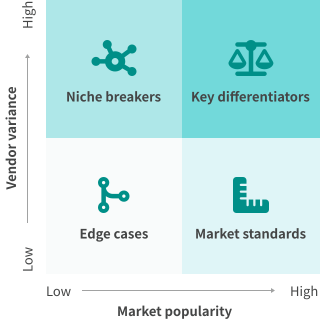
Key differentiators
🏗️Data architecture — unified vs. federated patient record
Whether all modules share one database or sync across separate stores, which determines clinical decision support accuracy and reporting integrity.
💸Total cost of implementation and long-term TCO
Licensing, implementation services, and ongoing admin overhead vary by an order of magnitude across platforms at similar feature parity.
🤖AI documentation assistance and ambient capture depth
Platforms diverge sharply between basic template auto-fill and real-time ambient note generation that reduces per-encounter documentation time.
🔄Interoperability and FHIR API maturity
Native FHIR conformance versus bolted-on adapters determines whether external data exchange requires custom development or just configuration.
📊Regulatory reporting automation ceiling
How far CMS quality measure submission, MIPS reporting, and payer audit documentation can proceed without manual staff intervention.
💰Revenue cycle intelligence and denial recovery
Network-wide claim learning versus locally maintained billing rules creates compounding denial-rate divergence across platforms over time.
Niche breakers
📵Offline-capable field documentation
Home health and hospice teams without reliable connectivity cannot use platforms that require a live connection to save or submit visit notes.
🏛️On-premise deployment option
Health systems in regulated jurisdictions or with strict data sovereignty requirements cannot operate on cloud-only platforms regardless of features.
🧬Discipline-specific clinical template depth
Specialty practices that cannot find pre-built templates for their documentation norms face months of build work that erases any time-to-value advantage.
🔒HIPAA-compliant telehealth and consent management
Behavioral health practices using non-native video tools risk compliance exposure that purpose-built platforms prevent by architectural design.
📋Post-acute assessment compliance logic — OASIS, MDS, hospice
Agencies submitting OASIS or MDS without embedded validation logic face pre-bill audit overhead that cloud-generic EHRs cannot eliminate.
Market standards
🔐HIPAA compliance and role-based access controls
Every viable platform provides baseline HIPAA safeguards and configurable user permissions — absence disqualifies a product immediately.
🗓️Integrated scheduling and appointment management
Unified scheduling linked to the clinical record is a baseline expectation across all care settings — standalone scheduling is no longer a differentiator.
📤Electronic claims submission and ERA posting
Direct payer connectivity for claim submission and remittance posting is table stakes — manual 837 file handling is disqualifying for modern practices.
📱Mobile chart access for clinicians
Browser-based or native mobile access to patient records is a baseline requirement; thick-client-only platforms fail basic clinician mobility needs.
Edge cases
🌐Multi-language patient-facing interfaces
Practices serving non-English-speaking populations need patient portals and intake forms in multiple languages — most platforms offer English only.
🏥Critical access hospital cost reporting modules
CAHs require Medicare cost report preparation tools that are irrelevant to most buyers but eliminate non-compliant platforms outright for this segment.
⚙️Legacy ADT feed integration with existing hospital systems
Health systems mid-migration from a prior EHR need ADT interface compatibility that cloud-native ambulatory platforms are not designed to provide.
How to choose
1.Workflow design
Start from the clinical and administrative work you need the platform to make reliable, not from a vendor demo. Define the care setting, the clinician roles involved, the documentation obligations triggered at each encounter, and the billing events that follow. Map the workflow end to end — for example, trace a home health OASIS assessment from the patient's bedside through claim submission — before evaluating any platform. Workflows you cannot trace on paper will not improve inside a system you cannot yet configure.
Still looking for the perfect fit?
Whether you want our AI-powered engine to recommend the best match for your goals or prefer to browse our comprehensive directory, we have you covered.
Frequently asked questions
What is health care software, in practical terms?
Who are the primary users of health care software?
What are the key benefits of implementing the right platform?
Unpleasant truth: Why do health care software implementations fail so often?
Unpleasant truth: What hidden costs appear after go-live?
Unpleasant truth: Do AI documentation tools actually reduce clinician burden?
How should we decide between an all-in-one platform and best-of-breed point solutions?
What pricing models are common in health care software?
What is the minimum viable setup for a small outpatient practice?
What integrations matter most when evaluating health care software?
How do we evaluate regulatory reporting depth before committing?
What are the most common challenges after go-live?
What certifications should health care software carry?
What are the main trends shaping health care software in the next few years?
What should we do if no platform on our shortlist fits all our requirements?


