
Find your right-fit generative AI, agents, apps.
Best health care software for one-person February 2026
Which best describes what you want to do?
Top picks by use case
All-in-one solo practice management
Target audience
Independent physicians, NPs, or allied health providers running a solo practice without dedicated admin staff.
Overview
Designed for solo providers who cannot afford the cognitive overhead of stitching together separate tools for every administrative task. These platforms consolidate scheduling, charting, billing, and patient communication under a single login, trading specialty-specific depth for the operational simplicity a one-person practice demands.
Fit & gap perspective
📋Integrated scheduling and charting
Appointment booking and clinical notes share one system, eliminating manual data re-entry between tools.
💳Self-service billing
Insurance claim submission and patient invoicing manageable by one person without a dedicated medical biller.
Top picks

Our pick for: Unified charting, scheduling, and billing


$54 per month
 Free Trial unavailableFree version unavailable

Small

Medium

Large

-
FitGaps's take


Pros and cons


Our pick for: Free-tier solo starter

$23 per user per month
 Free TrialFree version
Small
Medium
Large
- Healthcare and life sciences
- Information technology and software
- Public sector and nonprofit organizations
FitGaps's take

Pros and cons
Our pick for: Streamlined solo workflow

$15 per month
Free TrialFree version unavailableSmall
Medium
Large
- Healthcare and life sciences
- Professional services (engineering, legal, consulting, etc.)
- Media and communications
FitGaps's take

Pros and cons
Solo therapist and behavioral health
Target audience
Solo psychologists, licensed counselors, social workers, or occupational therapists in private practice.
Overview
Built around the documentation and compliance requirements unique to behavioral health, these platforms provide therapy-specific note formats and built-in teletherapy out of the box. A solo therapist gets a purpose-fitted workflow without adapting a general medical platform to fit clinical needs it was never designed to meet.
Fit & gap perspective
📝Therapy note templates
Pre-configured DAP, SOAP, and treatment plan formats that meet behavioral health documentation standards out of the box.
🖥️Built-in teletherapy
HIPAA-compliant video sessions embedded directly in the platform without requiring third-party video tools.
Top picks
Our pick for: Therapy-specific documentation

$69 per month
Free TrialFree version unavailableSmall
Medium
Large
- Arts, entertainment, and recreation
- Healthcare and life sciences
- Professional services (engineering, legal, consulting, etc.)
FitGaps's take

Pros and cons
Our pick for: Affordable solo therapist suite

$27 per therapist per month
Free TrialFree version unavailableSmall
Medium
Large
- Arts, entertainment, and recreation
- Healthcare and life sciences
- Professional services (engineering, legal, consulting, etc.)
FitGaps's take

Pros and cons
Our pick for: Teletherapy-integrated practice tool

$19.50 per month
Free TrialFree version unavailableSmall
Medium
Large
- Healthcare and life sciences
- Public sector and nonprofit organizations
- Information technology and software
FitGaps's take

Pros and cons
AI clinical documentation assistant
Target audience
Solo physicians, specialists, or NPs seeking to eliminate manual charting and reduce documentation burnout.
Overview
Targeted at solo clinicians losing evenings to after-visit note writing, these tools listen to live encounters and generate structured clinical notes automatically. The trade-off is intentional: narrower feature scope focused entirely on documentation speed, not full practice management.
Fit & gap perspective
🎙️Ambient listening
Captures natural clinician-patient conversation passively and converts it into structured, ready-to-sign clinical notes.
🔗EHR compatibility
Exports or pushes generated notes into existing EHR systems without manual copy-paste between interfaces.
Top picks
Our pick for: Ambient AI note generation
 Free TrialFree version
Small
Medium
Large
- Education and training
- Information technology and software
- Healthcare and life sciences
FitGaps's take

Pros and cons
Our pick for: Budget-friendly AI scribe

$79 per user per month
Free TrialFree versionSmall
Medium
Large
- Information technology and software
- Media and communications
- Professional services (engineering, legal, consulting, etc.)
FitGaps's take

Pros and cons
Our pick for: Voice-driven EHR note entry

Contact the product provider
Free Trial unavailableFree version unavailableSmall
Medium
Large
- Information technology and software
- Healthcare and life sciences
- Media and communications
FitGaps's take

Pros and cons
Virtual-first solo telehealth
Target audience
Solo telehealth providers, concierge physicians, or remote-first therapists who see patients primarily via video.
Overview
Purpose-fitted for solo providers running a fully remote or hybrid practice without a physical front desk. These platforms close the entire patient visit loop — intake, HIPAA-compliant video consult, and follow-up — prioritizing patient ease-of-use and connection reliability over advanced charting depth.
Fit & gap perspective
🔒HIPAA-compliant video
End-to-end encrypted video sessions backed by a signed BAA included as a standard plan provision.
🚪Virtual waiting room
Patients check in and queue online independently, requiring no receptionist to manage appointment flow.
Top picks
Our pick for: Zero-install patient video visits

Pay-as-you-go
Free Trial unavailableFree versionSmall
Medium
Large
- Professional services (engineering, legal, consulting, etc.)
- Retail and wholesale
- Healthcare and life sciences
FitGaps's take

Pros and cons
Our pick for: Enterprise-grade telehealth compliance

$25 per month
Free TrialFree version unavailableSmall
Medium
Large
- Professional services (engineering, legal, consulting, etc.)
- Media and communications
- Arts, entertainment, and recreation
FitGaps's take

Pros and cons
Our pick for: Configurable virtual clinic

$29 per provider per month
Free TrialFree versionSmall
Medium
Large
- Professional services (engineering, legal, consulting, etc.)
- Media and communications
- Information technology and software
FitGaps's take

Pros and cons
Selection compass: how to prioritize requirements
What is selection compass?
FitGap scored 184 one-person health care software products against a requirement framework shaped by real-world buyer research — with verified specifications across dozens of evaluation axes and current pricing data — to identify where vendor approaches diverge most for solo operators.
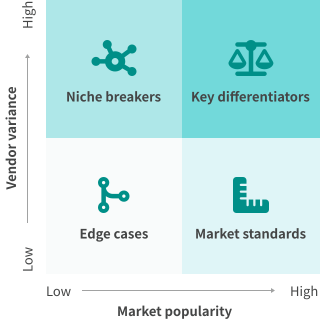
Key differentiators
🔗Workflow integration depth
Whether scheduling, charting, and billing share a unified data model or require manual handoffs between modules.
💸Solo-operator pricing structure
Flat monthly fee vs. per-client or per-encounter pricing creates order-of-magnitude cost variance across caseload fluctuations.
🤖AI documentation capability
Range from zero automation to ambient listening that generates structured notes during the live encounter.
🖥️Telehealth nativity
Whether video is architecturally embedded or bolted on, determining session reliability and documentation continuity.
📋Specialty-specific template depth
General SOAP templates versus pre-built formats mapped to behavioral health, primary care, or specialty billing codes.
🔄EHR portability and data ownership
How easily a solo provider can export clinical records and migrate away without losing documentation history.
Niche breakers
📜BAA inclusion as standard
Platforms without a signed Business Associate Agreement included by default are non-viable for any HIPAA-covered practice.
🏛️Behavioral health billing code support
Solo therapists require CPT and diagnostic codes specific to behavioral health; absence forces manual workarounds that create claim errors.
📡Low-bandwidth video reliability
Providers serving rural or connectivity-limited patients need a video engine that sustains sessions below standard broadband thresholds.
🔌EHR push integration
AI scribe tools that store notes in a proprietary format rather than pushing to the provider's EHR create a parallel record system.
Market standards
📅Online patient self-scheduling
Basic appointment booking accessible to patients without provider intervention is expected across all solo-operator platforms.
🔐End-to-end encrypted communications
Secure messaging and file sharing meeting minimum HIPAA standards for patient-provider communication.
📱Mobile-accessible interface
A solo provider must be able to review notes, messages, and schedules from a phone without a full desktop session.
Edge cases
🌐No-download patient video access
Browser-native video sessions matter only when a provider's patient population is older or less technically confident.
🗂️Wiley treatment planner integration
Relevant only for therapists who rely on evidence-based Wiley content and want to eliminate it as a separate subscription.
🏷️Branded virtual clinic environment
Practice-branded intake and waiting room matter when patient perception of professionalism drives retention in a solo practice.
How to choose
1.Workflow design
Start by mapping every administrative and clinical task you personally handle in a patient day — scheduling, intake, charting, billing, follow-up, and communication. Write each as a concrete step with a clear output. For example, trace what happens between a patient booking an appointment and a claim reaching the payer: how many systems do you touch, and where do you re-enter the same data? These handoff points are where solo operators lose the most time and where the right platform eliminates friction entirely.

Still looking for the perfect fit?
Whether you want our AI-powered engine to recommend the best match for your goals or prefer to browse our comprehensive directory, we have you covered.
Frequently asked questions
What is health care software for a solo provider, in practical terms?
Do solo providers actually need practice management software, or will general tools work?
What does a BAA mean, and why does it matter for a solo provider?
Can a solo provider realistically handle insurance billing without dedicated staff?
What is the difference between an AI scribe and a full documentation platform?
Unpleasant truth: How much time do solo providers actually spend on documentation after switching to AI tools?
What is the minimum viable software setup for a solo practice just launching?
How should a solo therapist decide between a general EHR and a behavioral health-specific platform?
Unpleasant truth: What happens when a solo provider's free-tier platform forces a sudden upgrade?
Is telehealth video embedded in a practice management platform better than a standalone tool?
Unpleasant truth: Do AI scribe tools actually work across all clinical specialties?
What pricing model is most cost-effective for a solo provider with an irregular caseload?
Can a solo provider switch platforms without losing clinical records?
What should a solo telehealth provider test before committing to a video platform?
How does a solo provider evaluate whether an all-in-one platform is genuinely unified or just bundled?


