
Find your right-fit generative AI, agents, apps.
Best e-commerce software February 2026
Which best describes what you want to do?
Top picks by use case
Quick-launch hosted storefront
Target audience
Small businesses, solo entrepreneurs, and first-time online sellers who need a turnkey store with minimal technical skill.
Overview
Built for sellers who need to be live and transacting within hours, not weeks. These platforms absorb all hosting, security, and infrastructure decisions so merchants can focus entirely on products and marketing, accepting constrained architectural flexibility in exchange for zero DevOps burden.
Fit & gap perspective
⏱️Instant setup
Pre-built themes and guided wizards that produce a fully functional live store within a single day.
💳Built-in payments
Native payment processing that requires no separate merchant account setup or third-party gateway integration.
Top picks

Our pick for: Fastest path from idea to live store


€5 per month
 Free Trial
 Free version unavailable

Small

Medium

Large

- Arts, entertainment, and recreation
- Retail and wholesale
- Agriculture, fishing, and forestry
FitGaps's take


Pros and cons


Our pick for: Visual drag-and-drop store building

$17.77 per month
Free TrialFree versionSmall
Medium
Large
- Retail and wholesale
- Accommodation and food services
- Agriculture, fishing, and forestry
FitGaps's take

Pros and cons
Our pick for: Unified online and in-person selling

$49 per location per month
Free TrialFree versionSmall
Medium
Large
- Accommodation and food services
- Arts, entertainment, and recreation
- Retail and wholesale
FitGaps's take

Pros and cons
Enterprise omnichannel platform
Target audience
Mid-market to enterprise retailers and brands with dedicated IT teams managing multi-region, multi-channel commerce operations.
Overview
Designed for large retailers whose operational complexity demands centralized governance across catalogs, storefronts, and regions. These platforms prioritize process control, deep ERP integration, and multi-channel order orchestration over speed of initial deployment.
Fit & gap perspective
🌐Multi-storefront management
Single-admin control over multiple branded storefronts with shared catalog, inventory, and pricing governance.
🔗ERP and back-office integration
Pre-built connectors or robust APIs enabling real-time data sync with ERP, OMS, and warehouse systems.
Top picks
Our pick for: Extensible enterprise catalog management

Contact the product provider
Free Trial unavailableFree version unavailableSmall
Medium
Large
- Retail and wholesale
- Manufacturing
- Real estate and property management
FitGaps's take

Pros and cons
Our pick for: ERP-native enterprise commerce

Contact the product provider
Free Trial unavailableFree version unavailableSmall
Medium
Large
- Real estate and property management
- Retail and wholesale
- Healthcare and life sciences
FitGaps's take

Pros and cons
Our pick for: SaaS scale without infrastructure overhead

$29 per month
Free TrialFree version unavailableSmall
Medium
Large
- Retail and wholesale
- Manufacturing
- Agriculture, fishing, and forestry
FitGaps's take

Pros and cons
Headless and composable commerce
Target audience
Digital-native brands and technology teams with front-end engineering capacity who need API-first commerce infrastructure.
Overview
Addresses the fundamental tension between branded UX control and monolithic platform lock-in. By delivering commerce logic as discrete APIs, these platforms let engineering teams compose best-of-breed services and swap individual components without disrupting the broader architecture.
Fit & gap perspective
📡API-first architecture
All commerce functions exposed as RESTful or GraphQL APIs with no mandatory front-end storefront layer.
🔀Composability
Independent replacement or upgrade of individual commerce services — search, checkout, or payments — without full-platform redeployment.
Top picks
Our pick for: Cloud-native MACH architecture
Contact the product provider
Free TrialFree version unavailableSmall
Medium
Large
- Information technology and software
- Media and communications
- Retail and wholesale
FitGaps's take
Pros and cons
Our pick for: Composable commerce with catalog flexibility

$2,200 per month
Free TrialFree version unavailableSmall
Medium
Large
- Information technology and software
- Media and communications
- Healthcare and life sciences
FitGaps's take

Pros and cons
Our pick for: API-first multi-market commerce

Contact the product provider
Free Trial unavailableFree versionSmall
Medium
Large
- Information technology and software
- Retail and wholesale
- Media and communications
FitGaps's take

Pros and cons
B2B and wholesale commerce
Target audience
Manufacturers, distributors, and wholesalers selling to business buyers who require custom pricing, credit terms, and bulk ordering.
Overview
Solves the structural mismatch between consumer-oriented platforms and the realities of business procurement. These tools provide native support for negotiated pricing, purchase order workflows, and buyer self-service portals, eliminating the costly extensions B2B sellers typically bolt onto consumer-focused storefronts.
Fit & gap perspective
🏷️Account-specific pricing
Per-buyer assignment of negotiated price lists, tiered volume discounts, and contract payment terms.
📋Quote and order approval workflows
Native RFQ submission, multi-level approval chains, and purchase order acceptance designed for business procurement cycles.
Top picks
Our pick for: Purpose-built B2B commerce

Contact the product provider
Free Trial unavailableFree versionSmall
Medium
Large
- Manufacturing
- Agriculture, fishing, and forestry
- Construction
FitGaps's take

Pros and cons
Our pick for: ERP-integrated B2B web store

Contact the product provider
Free TrialFree version unavailableSmall
Medium
Large
- Manufacturing
- Construction
- Healthcare and life sciences
FitGaps's take

Pros and cons
Our pick for: CRM-connected buyer experience

Contact the product provider
Free Trial unavailableFree version unavailableSmall
Medium
Large
- Professional services (engineering, legal, consulting, etc.)
- Real estate and property management
- Manufacturing
FitGaps's take

Pros and cons
Selection compass: how to prioritize requirements
What is selection compass?
FitGap scored 1,168 e-commerce products against a requirement framework shaped by real-world buyer research — with verified specifications across dozens of evaluation axes and current pricing data — to identify where vendor approaches diverge most and where the market has converged.
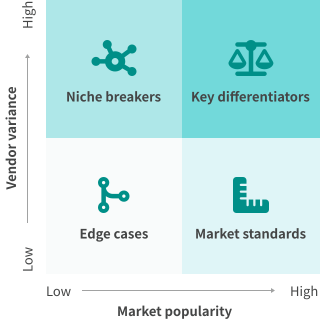
Key differentiators
🏗️Commerce data model flexibility
How far you can extend product types, attributes, and relationships without forking core platform code or building brittle workarounds.
⚙️Total cost of ownership at scale
Hidden infrastructure, customization, and maintenance costs that compound as catalog size, traffic, and channel count grow.
🔄Integration architecture and sync fidelity
Whether ERP, OMS, and PIM connections use real-time APIs or batch syncs, directly affecting inventory accuracy and pricing reliability.
🚀Checkout conversion tooling and extensibility
Depth of A/B testing, one-page checkout customization, and payment method coverage that vendors diverge on sharply.
🌍Multi-market and multi-currency governance
Whether per-market pricing, tax, and fulfillment rules are first-class configuration objects or manual per-storefront duplications.
📦Order management and fulfillment orchestration
Native split-shipment, backorder, and routing logic versus reliance on third-party OMS to fill critical post-purchase gaps.
Niche breakers
🔒On-premise or private-cloud deployment
Vendors without self-hosted deployment options are non-viable for regulated industries where data residency prohibits SaaS.
📋Native purchase order and RFQ workflows
Platforms lacking built-in PO acceptance and approval chains cannot serve B2B buyers whose procurement requires them.
📡Fully headless API-first architecture
Platforms that couple front-end rendering to back-end logic are eliminated outright when engineering teams must own the presentation layer.
🔗Deep ERP real-time integration
Batch-sync-only connectors fail organizations where inventory accuracy and contract pricing must reflect live ERP state at checkout.
♿Accessibility compliance certification
Vendors without audited WCAG 2.1 AA compliance are non-viable for public-sector or regulated-market storefronts.
Market standards
💳Major payment gateway support
Stripe, PayPal, and regional gateway integrations are expected baseline; absence disqualifies a product in most markets.
🔐PCI DSS compliance and SSL management
Automated certificate management and PCI scope handling that merchants should not need to configure or maintain manually.
📱Mobile-responsive storefront rendering
Themes and checkout flows that render correctly on mobile without custom engineering are a non-negotiable baseline expectation.
📊Built-in analytics and sales reporting
Revenue, conversion, and traffic dashboards that function out of the box without requiring a separate BI tool for basic visibility.
Edge cases
🖨️ERP-native document generation
Automated invoice, packing slip, and customs document output required by distributors operating under strict procurement paper trails.
🏭Configure-price-quote (CPQ) integration
Native or deeply integrated CPQ matters only for manufacturers whose products require guided configuration before a price can be calculated.
🗣️Right-to-left language and locale support
Full RTL rendering and locale-specific date and currency formats, decisive for brands expanding into Arabic or Hebrew markets.
How to choose
1.Workflow design
Start by mapping the commerce work the platform must make reliable. Define the actors — merchants, buyers, warehouse staff, ERP operators — and the key inputs and outputs at each stage: a product listing in, a fulfilled order out. Write the critical paths as concrete scenarios, such as how a B2B buyer submits a purchase order against a negotiated price list, or how a flash sale drives a traffic spike that must not cause inventory oversells. These scenarios become your PoC test scripts.

Still looking for the perfect fit?
Whether you want our AI-powered engine to recommend the best match for your goals or prefer to browse our comprehensive directory, we have you covered.
Frequently asked questions
What is e-commerce software, in practical terms?
Who uses e-commerce software inside a company?
What are the key benefits of e-commerce software?
Unpleasant truth: Why do e-commerce platform migrations fail so often?
Unpleasant truth: What hidden costs accumulate after go-live?
Unpleasant truth: When does a 'flexible' platform become a maintenance burden?
What is the difference between headless and traditional e-commerce?
How many e-commerce platforms should we evaluate seriously?
SaaS hosted vs. self-managed: How should we decide?
What pricing models are common for e-commerce software?
What integrations matter most in an e-commerce platform decision?
What is the minimum viable e-commerce setup for a small business?
How do we evaluate platform performance before committing?
What are the main e-commerce software trends shaping platform decisions now?
What if no platform fits our requirements?


